Updated June 23, 2026 · Pricing and features verified 2026
Key takeaways
- Lemon Learning balances simplicity, fast deployment, and broad coverage for most teams.
- WalkMe scales to the largest, most complex enterprise rollouts.
- Pendo leads when you need product analytics alongside in-app guidance.
- None publish pricing; Lemon Learning is generally the most accessible and predictable.
Rolling out a new CRM, ERP, or HR system and watching your teams struggle to keep up? That’s exactly the problem digital adoption platforms (DAPs) are built to solve. These software overlays guide your users directly inside the application, in real time, to speed up onboarding and cut down support tickets.
In this guide, we compare three leading platforms, Lemon Learning, WalkMe, and Pendo, breaking down their strengths, their limits, and the kind of organization each one fits best. And if you only have time to look at one, our top pick for most teams is Lemon Learning.
Our picks
- Lemon Learning, our favorite: simple, fast to deploy, and built to drive real adoption without heavy overhead
- WalkMe, the enterprise reference for adoption at massive scale
- Pendo, the best choice for product analytics paired with in-app guidance
Our methodology
We evaluated each platform against the same criteria:
- Ease of content creation: how long does it take to build a first step-by-step guide, and do you need a developer or technical skills to do it?
- Analytics: depth of usage data, user behavior tracking, and the ability to measure adoption and ROI.
- Application coverage: compatibility with web apps (CRM, ERP, HR systems), but also more complex environments (SAP GUI, Citrix, desktop applications).
- Pricing and transparency: pricing model, how predictable the bill is, and whether you’re locked into opaque quotes and multi-year contracts.
- Support and onboarding: responsiveness, quality of follow-up, and how close the team is to you.
- Deployment speed: how quickly your team can own the tool and ship guidance.
All the platforms in this comparison run no-code (or nearly so) and typically install via a simple snippet or extension.
Lemon Learning: our #1 pick for digital adoption
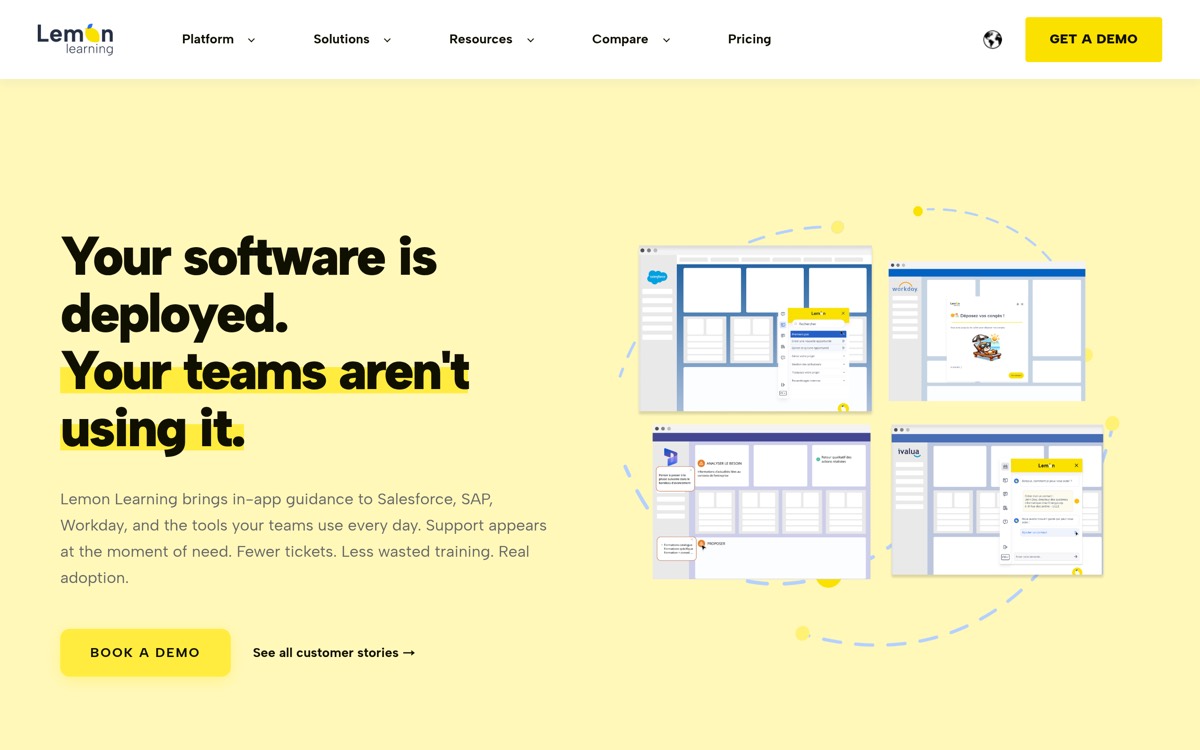
What is Lemon Learning?
Lemon Learning is a digital adoption platform designed as a simpler, more agile alternative to heavyweight enterprise DAPs. Think of it as GPS navigation for any web-based software: interactive, in-app walkthroughs guide users step by step, directly inside whatever tool they’re using, whether it’s a market leader like Salesforce, Microsoft 365, Workday, or ServiceNow, or a custom application built in-house.
The platform supports everyone from small businesses to global enterprises, with reference clients including KPMG, Chanel, Randstad, and Aéroports de Paris. It’s already used by millions of users worldwide, and it’s expanding fast across both European and US markets.
Why Lemon Learning is our favorite
Strengths
- Fast deployment: a simple editor, no-code guide creation, and teams up and running in just a few hours. No dedicated adoption team or outside consultants required, your people own the work.
- Effortless for end users: teams genuinely appreciate being guided step by step, which sharply reduces tier-1 support requests and that “I’m lost in this new tool” feeling.
- Powerful push system: send targeted pop-ups and notifications to a specific user segment in under a minute, with no publishing delay.
- Truly broad coverage: web, SaaS, in-house tools, and even complex desktop environments (SAP GUI, Citrix, .NET, Java), where many DAPs stop at the browser.
- Multilingual by design: support for a wide range of languages, ideal for international rollouts.
- Responsive, human support: a team that answers fast and stays close to you throughout the project.
- Enterprise-grade data governance: European hosting and GDPR compliance by default, a strong reassurance for regulated industries like finance, healthcare, and the public sector, on both sides of the Atlantic.
Limitations
- Analytics still maturing: some users find the KPIs and dashboards less exhaustive than the pricier incumbents.
- Customization geared toward simplicity: built for non-technical profiles, which can constrain a few very advanced use cases.
- AI layer in progress: several users would like deeper AI features (they’re rolling out progressively).
Who is Lemon Learning best for?
- Mid-market companies and growing enterprises that want a quick rollout without an enterprise-sized budget or a dedicated adoption team.
- Regulated industries (public sector, finance, healthcare) that value strong data governance and GDPR compliance.
- Teams running complex stacks (SAP, Citrix, in-house apps) that need guidance beyond the browser.
- Training and change-management teams that prioritize easy guide creation and hands-on support.
Pricing
Lemon Learning works on a custom quote based on the number of users and the features you need, on a SaaS subscription model. Pricing isn’t public, but it’s generally seen as more accessible and more predictable than the US giants, a strong value-for-money proposition for most organizations.
WalkMe: the reference for very large enterprises
What is WalkMe?
Founded in 2011 and based in California, WalkMe is the category pioneer, the company that popularized the term “Digital Adoption Platform.” It targets large organizations rolling out complex software at massive scale, and is used by more than 2,000 companies worldwide, including a large share of the Fortune 500 (IBM, Nestlé, the US federal government, and more).
Why consider WalkMe
Strengths
- Adoption at massive scale: built for complex, multi-application, multi-region deployments.
- Powerful analytics: behavioral segmentation, funnels, journeys, customizable dashboards.
- Broad coverage: web, mobile, and heavy environments like SAP GUI.
- Mature ecosystem: 70+ integrations, an active community, and regular updates.
Limitations
- High, opaque pricing: no public rates, custom quotes, multi-year commitments. Market data puts the average cost around $79,000 per year, climbing into six figures for larger deployments.
- Steep learning curve: content creation and maintenance are time-consuming, and advanced cases can require code (jQuery).
- Heavy maintenance: every change to the underlying app can break existing guides.
- Inconsistent support: fast initial replies, but resolution can drag, according to user reviews.
Who is WalkMe best for?
- Large enterprises with a dedicated adoption team and a sizable budget.
- Organizations with very complex environments that need fine-grained control of adoption at global scale.
Pricing
WalkMe doesn’t publish its rates. Pricing depends on monthly active users (MAU), the applications covered, the modules selected, and your negotiating leverage. Implementation costs add anywhere from a few thousand to $50,000+. Clearly positioned at the enterprise tier.
Pendo: the best choice for product analytics
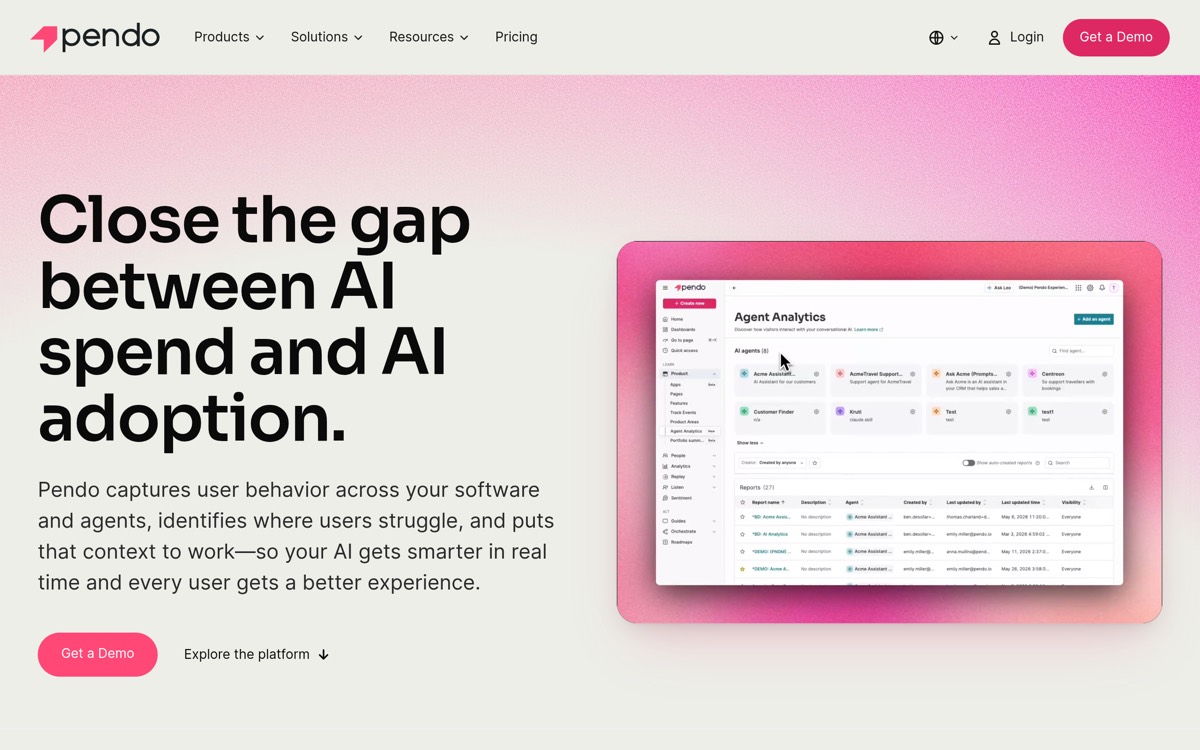
What is Pendo?
Founded in 2013 in Raleigh, Pendo is first and foremost a product experience platform, combining product analytics, in-app guidance, feedback collection, and roadmapping. Pendo claims 14,000+ customers and processes billions of events per day.
Why consider Pendo
Strengths
- Deep product analytics: behavior tracking, funnels, paths, and retroactive data from install.
- Guidance without developers: guides, tooltips, and walkthroughs built by non-technical users.
- All-in-one: analytics, guidance, NPS surveys, and feedback in a single platform.
- Granular segmentation: target by profile, behavior, region, or account tier.
Limitations
- Opaque, volume-based pricing: billed by monthly active users (MAU), with no public rates.
- Costly for small teams: the model can quickly exceed a modest budget.
- Data latency: roughly a 1-hour delay, a constraint for real-time interventions.
- Tedious tagging: tagging pages and features takes time and discipline.
- Web-centric: less comfortable in complex desktop environments.
Who is Pendo best for?
- B2B SaaS product teams that want to understand feature adoption and tie usage to feedback.
- Product-led companies looking to centralize data, guidance, and voice of the customer.
Pricing
Pendo offers a free tier (capped at 500 MAU) followed by paid plans (Base, Core, Ultimate) with unpublished rates, billed by monthly active users. AI modules are sold as add-ons.
Quick comparison
| Criteria | Lemon Learning | WalkMe | Pendo |
|---|---|---|---|
| Best for | Mid-market & growing enterprises | Large enterprises | B2B SaaS product teams |
| Key strength | Simplicity + fast deployment | Adoption at massive scale | Product analytics |
| Ease of onboarding | Fast (a few hours) | Steep curve | Moderate |
| Complex coverage (SAP, desktop) | Yes | Yes | Limited |
| Data governance (hosting / GDPR) | Strong, by default | Standard | Standard |
| Analytics | Solid, improving | Very advanced | Very advanced |
| Pricing | Custom quote, more accessible | High, opaque | MAU-based, opaque |
Frequently asked questions
What is a digital adoption platform (DAP)?
It’s a software overlay that sits on top of your applications and guides users in real time: step-by-step walkthroughs, tooltips, notifications, and automations. The goal is to speed up onboarding, reduce errors, and cut support tickets.
Which platform is the best value for most teams?
For the majority of organizations, Lemon Learning offers the strongest balance of simplicity, fast deployment, broad coverage, and accessible pricing. WalkMe makes sense for very large, complex enterprise rollouts, while Pendo is the pick when deep product analytics is the priority.
Do you need to code to use these tools?
No, all three are designed to be no-code for guide creation. WalkMe may still require code (jQuery) for advanced cases, while Lemon Learning gets teams self-sufficient in just a few hours.
Which one is the cheapest?
None publish their rates. Lemon Learning is generally seen as the most accessible and predictable, while WalkMe is the most expensive (around $79,000/year on average per market data). Pendo sits in between.
Does Lemon Learning work with SAP or desktop applications?
Yes. Lemon Learning supports complex environments like SAP GUI, Citrix, .NET, and Java, whereas Pendo stays mostly focused on web apps. That broader reach is one of its key advantages.
What about data governance and compliance?
Lemon Learning provides European hosting and GDPR compliance by default, which is reassuring for regulated industries everywhere. It’s a meaningful plus, not a constraint, the platform serves customers across both European and US markets.
Is Pendo a true DAP or an analytics tool?
Both. Pendo started on the product-analytics side and later added in-app guidance, feedback, and roadmapping. It’s the choice for teams whose primary goal is connecting usage data to adoption.
Want to dig deeper? Explore the digital adoption category or put any two of these tools head-to-head.