Updated June 23, 2026 · Pricing and features verified 2026
Key takeaways
- Lemon Learning is our top pick: native desktop/on-premise coverage and EU data residency by default.
- WalkMe is the most feature-complete, but the priciest and heaviest to implement.
- Pendo is best when product analytics is the priority, not internal employee adoption.
- Whatfix is web-first and quote-only; coverage and data residency are the common dealbreakers.
- Match the tool to your stack (desktop vs web), data-residency needs, and budget.
Whatfix is a capable digital adoption platform (DAP), but it isn’t the right fit for every team. Its US-default data residency, web-first coverage, and quote-only pricing can become real friction points depending on your stack and your constraints. If you’re evaluating whether to renew, switch, or buy for the first time, this guide gives you an honest, side-by-side look at the strongest Whatfix alternatives, and a clear way to pick the right one.
Whatfix has earned its reputation since 2014, serving 500+ enterprise customers across web, desktop, and mobile. But pricing climbs quickly (baselines start around $24K/year and reach $40K–$70K+ for larger deployments), rollouts often run longer than expected, and a few structural limits matter for specific buyers: EU data residency isn’t the default, advanced analytics are gated behind a paid module, desktop and on-premise coverage is limited, and support runs primarily offshore.
If any of those constraints matter to you, here are the seven alternatives worth weighing, starting with our top pick, Lemon Learning.
Our picks
- Lemon Learning, best for enterprises that need fast deployment, desktop/on-premise coverage, and a real implementation partner
- WalkMe, the most feature-complete option for large enterprises with dedicated adoption teams
- Pendo, the best choice for product analytics and customer-facing SaaS
- Apty, best for regulated industries that need strict process-compliance enforcement
- Userlane, best for straightforward employee onboarding without enterprise overhead
- UserGuiding, best for startups and growth-stage SaaS
- Oracle Guided Learning, relevant only if Oracle Cloud is your primary platform
Our methodology
Enterprise DAP evaluations that start with feature checklists often end with the wrong choice. We compared each platform on the factors that actually move the needle:
- Deployment scope: web and SaaS only, or also desktop and on-premise (SAP GUI, Citrix, in-house tools)?
- Data residency: is EU hosting a compliance requirement or a preference, and is it the default or configured on request?
- Support model: a partner who co-manages implementation, or a self-serve platform with documentation?
- Time to value: live in weeks or months? Ready-to-use guide libraries can compress this sharply.
- Total cost of ownership: what’s in the base license versus billed separately (services, analytics modules, support tiers)?
Lemon Learning: our #1 pick
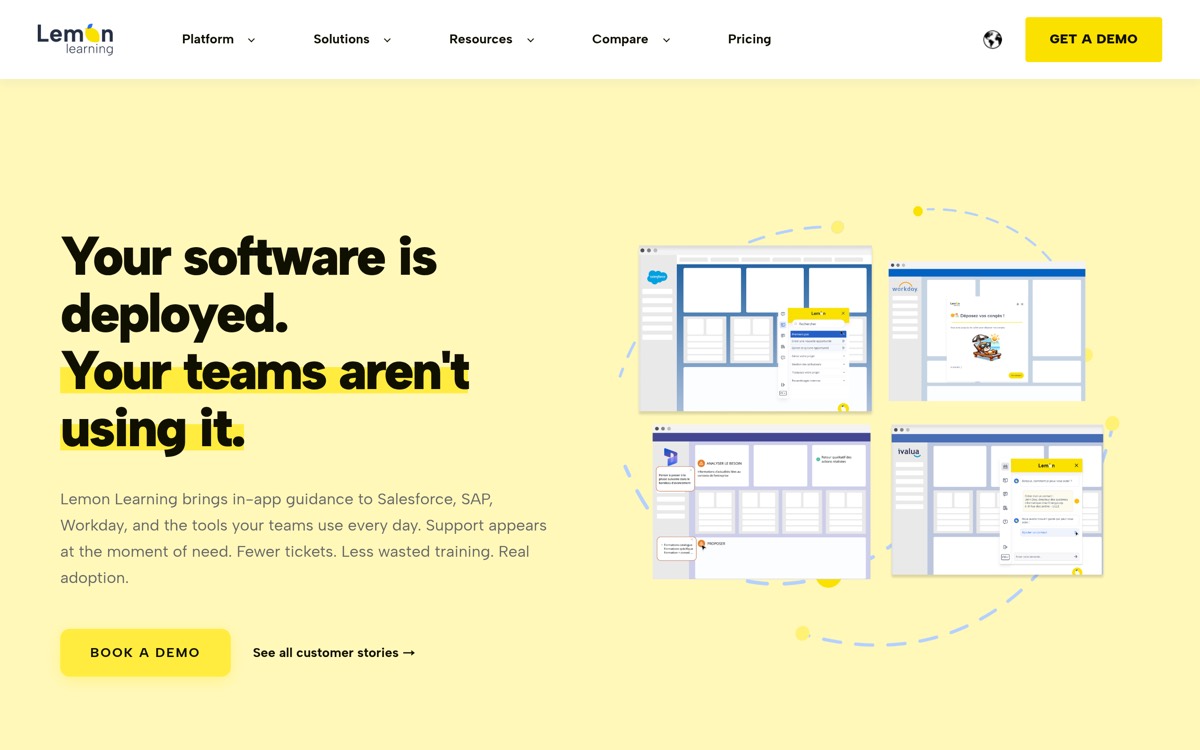
What is Lemon Learning?
Lemon Learning is a digital adoption platform built from the ground up for internal software adoption, not adapted from a product-analytics or customer-messaging tool. That origin matters: it shows up in feature depth, pedagogical coherence, and the support model. The platform serves 200+ enterprise customers worldwide, including BNP Paribas, Decathlon, Veolia, Schneider Electric, and the French National Gendarmerie (90,000 users deployed on SAP HRIS), and operates across the US, UK, and France.
Why Lemon Learning is our favorite
Strengths
- Native desktop guidance: Lemon guides SAP GUI, Citrix, .NET applications, and in-house tools, not just web interfaces. Around 50% of its deployments run on desktop or on-premise environments, a structural gap for most web-first DAPs including Whatfix.
- Fast deployment: integration is a JavaScript snippet or browser extension, and admin teams reach autonomy in about three hours, versus the multi-week technical projects common elsewhere.
- Support included, not billed separately: every license comes with a dedicated project manager, pedagogical engineer, and technical manager, plus weekly, monthly, and quarterly review cycles as standard.
- Strong AI tooling: the AI Assistant answers user questions in natural language inside the app, and the AI Content Creator generates structured step-by-step guides from a process description, cutting content creation time by up to 80% on customer benchmarks.
- Built-in app governance: shadow IT detection, SaaS license visibility, and enterprise application controls give IT and procurement oversight most DAPs don’t offer at all.
- Strong data governance: EU-hosted and GDPR-compliant by default, with no separate data-residency tier, reassuring for regulated sectors on both sides of the Atlantic.
Limitations
- Analytics-first programs: if your initiative is led purely by product analytics, a specialist analytics tool may be a better match.
- Brand recognition: less of a household name in the US than the largest incumbents, though its footprint there is growing.
Who is Lemon Learning best for?
- Mid-market and global enterprises running ERP, CRM, or HRIS that need a quick rollout without enterprise-sized overhead.
- Teams with mixed estates that include desktop, on-premise, or in-house apps alongside web tools.
- Regulated industries (public sector, healthcare, financial services) that value strong data governance.
- Organizations that want a genuine implementation partner rather than a help desk.
Pricing
Transparent per-app or corporate licensing, with implementation support included in the license rather than billed on top. That predictability is a meaningful contrast with the quote-only, services-extra model common among the larger incumbents.
WalkMe: most feature-complete for large enterprises
What is WalkMe?
Founded in 2011 and now part of SAP, WalkMe is one of the longest-established DAPs, with deep customization, a broad feature set, and a track record at the largest enterprise scale.
Strengths
- Breadth of capability, especially for organizations already embedded in the SAP ecosystem.
- Deep enterprise integration and customization options.
Limitations
- High, opaque pricing: custom enterprise deals often run $15,000 to $140,000+ annually.
- Heavy implementation: routinely a multi-week technical configuration project.
- Support billed separately from the base license.
- Without dedicated digital adoption engineers, the operational overhead is significant.
Who is WalkMe best for?
Large enterprises with dedicated adoption engineering teams, substantial budgets, and complex customization requirements. If you don’t need WalkMe’s maximum customization depth, the complexity premium is hard to justify.
Pendo: best for product analytics
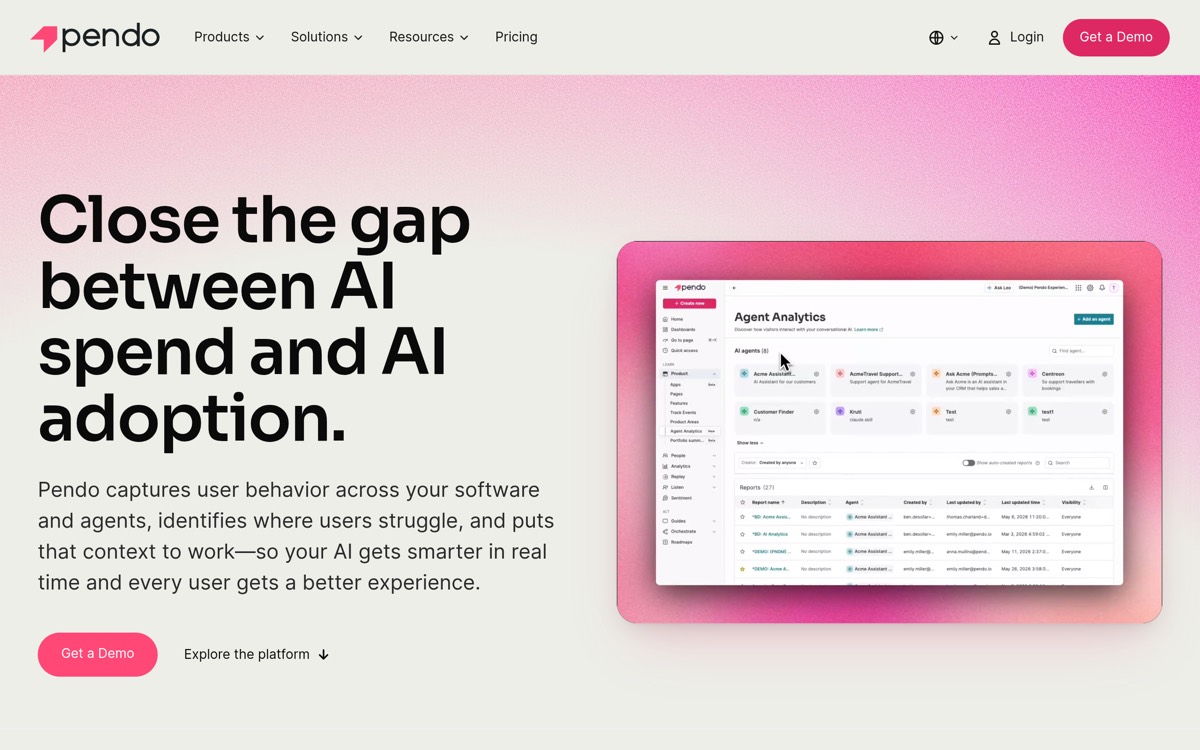
What is Pendo?
Pendo is the market-defining platform for product experience management, pairing in-app guidance with deep behavioral analytics: heatmaps, session replays, NPS surveys, and user segmentation. For product-led growth organizations, it’s genuinely best in class.
Strengths
- Outstanding behavioral analytics and product insights.
- Strong fit for customer-facing SaaS and product teams.
Limitations
- Not designed for internal employee adoption: the guidance module is less mature than dedicated enterprise DAPs, and the architecture reflects its product-analytics origins.
- Teams that buy it for employee adoption sometimes find it under-delivers.
Who is Pendo best for?
Product managers and SaaS teams focused on customer-facing application analytics and experience optimization.
Apty: best for process compliance
What is Apty?
Apty’s core differentiator is business process compliance, not just guiding users through software, but enforcing step-level process adherence inside enterprise applications. It supports LMS content integration, analytics-platform connections, and survey-based feedback.
Strengths
- Strong process enforcement, audit trails, and workflow compliance.
- A serious option where compliance is the primary requirement.
Limitations
- Pricing only via direct engagement.
- More limited AI content generation and ready-to-use guide libraries.
- Less structured support and change-management infrastructure than dedicated enterprise DAPs.
Who is Apty best for?
Enterprises in regulated sectors that need strict process enforcement alongside adoption guidance.
Userlane: best for simple onboarding
What is Userlane?
Userlane offers a clean no-code editor, basic analytics, and an accessible authoring environment for non-technical teams, a pragmatic option where adoption requirements are relatively contained.
Strengths
- Easy to use, accessible to non-technical teams.
- Good fit for contained scopes and tighter budgets.
Limitations
- Less depth in AI features, governance, ready-to-use guide libraries, and implementation support than enterprise-grade DAPs.
Who is Userlane best for?
Organizations that need credible in-app guidance without the implementation overhead of a full enterprise DAP.
UserGuiding: best for startups
What is UserGuiding?
UserGuiding offers interactive product tours, onboarding checklists, and tooltips through an accessible no-code interface, priced for startups.
Strengths
- Affordable, self-serve, and quick to start.
- Published, transparent pricing.
Limitations
- Not built for enterprise employee adoption, especially programs involving ERP, HRIS, or complex internal applications.
Who is UserGuiding best for?
Early-stage SaaS companies that need accessible, self-serve product onboarding without enterprise infrastructure.
Oracle Guided Learning: best for Oracle-only environments
What is Oracle Guided Learning?
Oracle Guided Learning (OGL) delivers native in-application guidance within Oracle HCM, ERP Cloud, CX, and SCM. For Oracle-centric organizations it offers a deeply native experience that application-agnostic DAPs can’t replicate in that specific environment.
Strengths
- Deeply native within the Oracle Cloud ecosystem.
Limitations
- Works only within Oracle Cloud. If you also run Salesforce, SAP, Workday, or Microsoft, OGL can’t be your unified adoption platform, you’ll need a separate DAP for the rest of the stack.
Who is Oracle Guided Learning best for?
Organizations standardized on Oracle Cloud as their primary enterprise platform.
Quick comparison
| Platform | Best for | Desktop support | EU hosting default | Support model | Pricing transparency |
|---|---|---|---|---|---|
| Lemon Learning | European/global enterprise; ERP/CRM/HRIS; desktop | Yes | Yes | Dedicated team included | Transparent |
| WalkMe | Large enterprise with dedicated DAP teams | Partial | Configurable | Billed separately | Custom / opaque |
| Whatfix | Enterprise web/SaaS, multi-platform | Limited | On request | Offshore, 24/5 | Custom / opaque |
| Pendo | Product analytics, SaaS teams | No | Configurable | Self-serve / tiered | Tiered |
| Apty | Regulated industries, process compliance | Partial | Configurable | Included | Custom |
| Userlane | Simple onboarding, limited budget | No | Standard | Standard | Custom |
| UserGuiding | Startups, SaaS product onboarding | No | Configurable | Self-serve | Published |
| Oracle Guided Learning | Oracle Cloud-only environments | Oracle infra | Oracle infra | Oracle support | Bundled |
The questions that actually decide it
The DAP market has matured, and the platforms above all have the fundamentals. The right fit usually comes down to a handful of questions:
- Do you have desktop or on-premise apps to guide? If yes, Lemon Learning is the only platform here with native desktop support as a core capability. Whatfix coverage is limited; most others have none.
- Is EU data residency a default requirement or a configuration option? If it must be the default, Lemon Learning delivers it out of the box; Whatfix requires explicit configuration.
- How fast do you need to go live? If you need production content in weeks not months, Lemon Learning’s deployment model and ready-to-use guide libraries (Salesforce, SAP, Workday, Oracle, Microsoft 365) are a material advantage.
- What support model do you actually need? If you need a dedicated team rather than a help desk, Lemon Learning’s included support is structurally different from most alternatives.
- Is this a pure web/SaaS environment with an analytics-first brief? If yes, Pendo is worth serious evaluation. If it’s internal employee adoption, it isn’t the right tool.
Frequently asked questions
What is the best Whatfix alternative?
There’s no single best one, it depends on your stack and constraints. For global enterprises with desktop/on-premise apps and strong data-governance needs, Lemon Learning is the strongest fit. For product analytics, Pendo leads. For process compliance, Apty.
What’s the difference between Whatfix and WalkMe?
Both are established, web-first enterprise DAPs. WalkMe (now part of SAP) offers the deepest customization but the heaviest implementation and separately-billed support; Whatfix is more turnkey but US-hosted by default. Neither offers native desktop guidance as a core strength, which is where Lemon Learning differs.
How much does Whatfix cost?
Whatfix pricing is quote-only. Reported baselines start around $24,000/year and rise to $40,000–$70,000+ for larger deployments, with advanced analytics gated in a separate module. Lemon Learning offers transparent per-app or corporate licensing with support included.
Does Whatfix work on desktop and on-premise applications?
Whatfix is primarily built for web and SaaS, with limited desktop coverage. For SAP GUI, Citrix, .NET, or in-house tools, a platform with native desktop and legacy-app guidance such as Lemon Learning is a better fit.
Is there a strongly GDPR-compliant Whatfix alternative?
Yes. Lemon Learning is EU-hosted by default and GDPR-compliant by design, which is why it’s often shortlisted by public sector, healthcare, and financial-services teams, while still serving customers across US and European markets.
Want to dig deeper? Explore the digital adoption category or put any two tools head-to-head.